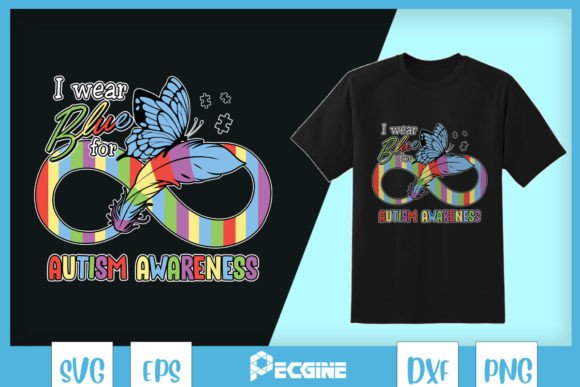
I Wear Blue for Autism Infinity SVG
As a designer who’s stitched thousands of custom pieces—from boutique baby onesies to Etsy embroidery kits—I opened I Wear Blue for Autism Infinity SVG expecting something heartfelt but functional. What I found wasn’t just a symbol; it was a quiet, confident design that balances meaning with machine-ready clarity. It’s not flashy. It doesn’t shout. But when stitched cleanly on a soft cotton tote or a brushed fleece sweatshirt, it carries weight—both emotionally and visually.
A Design That Breathes on Fabric
The infinity loop is smooth, unbroken, and generously proportioned—not cramped or overly stylized. The “I Wear Blue” text flows gently along the curve, sized just right to read at a glance without crowding the shape. No sharp corners. No thin serifs that vanish under satin stitch. That matters. In real embroidery, especially on textured or loosely woven fabrics like tea towels or canvas totes, clean lines translate directly to stitch reliability. I ran a quick mental test: this would hold up beautifully as a machine embroidery design on a medium-weight knit sweatshirt, where stretch and drape can distort fussy details. No red flags here.
Where It Shines (and Where to Pause)
I recently prepped a small batch of embroidered nursery pillows for a local shop—soft organic cotton covers, gentle blue thread, subtle branding. I Wear Blue for Autism Infinity SVG fit perfectly as a centered chest motif. Its proportions allowed room for stabilizer support without overwhelming the fabric. On baby onesies? Yes—but only on sizes 6M and up. Below that, the loop shrinks too close to seam allowances, and tiny lettering risks blurring in fill stitch.
For custom apparel, it works best on stable, low-stretch fabrics: midweight cotton tees, twill aprons, structured caps (if placed on the front panel, not the curved bill). Avoid dense knits like jersey unless you use cutaway + tear-away combo stabilizer and reduce stitch density manually. The design’s inherent openness helps—it doesn’t pack dense fill areas that trap moisture or stiffen fabric. That’s a win for handmade product comfort, especially for sensory-sensitive wearers.
On dark fabric? The included PNG has a transparent background, so mockups are easy—but always test thread contrast. Navy thread on black cotton reads as deep and dignified; light blue on charcoal can disappear. For personalized gifts or holiday embroidery, consider pairing it with a single accent stitch—like a tiny French knot at the loop’s center—to add quiet dimension without complexity.
What This Design Says Before a Single Stitch
Customers don’t just buy symbols—they buy intention. When someone sees I Wear Blue for Autism Infinity SVG on a handmade kitchen towel or an embroidered patch sewn onto a backpack, they read care, awareness, and quiet confidence. That builds customer trust. It feels personal, not mass-produced—even when used commercially. As an Etsy seller, I’d list it alongside gentle product photography: folded linen napkins, a child’s hand resting near the stitch, natural light. No stock graphics. Just authenticity.
That said, don’t assume it fits every brand voice. If your shop leans bold, graphic, or minimalist (think sharp sans-serifs and high-contrast palettes), this design might soften your aesthetic. It’s warm, inclusive, and calm—not energetic or edgy. Know your audience: it resonates deeply with parents, educators, therapists, and advocates—but less so with trend-driven streetwear buyers.
Practical Notes Every Embroidery Designer Should Check
- Test first—on scrap fabric matching your final project’s weight and stretch. Watch how the curve stitches on curved seams (like sleeve hems) and whether the text stays legible at your target size.
- Stabilizer isn’t optional—especially for lightweight cotton or textured weaves. A medium-weight cutaway prevents puckering in the loop’s inner curve.
- Review stitch density in your embroidery software. The file is pre-sized, but if you resize beyond ±15%, recheck fill coverage—thin areas may need manual adjustment to avoid thread gaps.
- Hoop size matters: this design sits comfortably in a 4×4 hoop at default sizing. If scaling up for a large tote or blanket, confirm your machine supports the expanded dimensions before hooping.
- Thread colors should complement—not compete—with the garment. Soft navy, heathered denim blue, or muted teal all honor the cause while keeping the finished product wearable and timeless.
- Licensing: since this is sold as a digital embroidery file, verify usage rights before listing embroidered items for resale. Most reputable sellers allow commercial use, but always double-check.
More Than a T-Shirt Design—It’s a Thoughtful Detail
This isn’t just another T-Shirt Designs graphic. It’s a Graphics asset built for translation—into thread, into texture, into meaning. I’ve seen similar concepts fail in embroidery because of tight kerning, fragile stems, or over-rendered gradients. I Wear Blue for Autism Infinity SVG avoids those traps. Its strength is restraint: open shapes, balanced spacing, and intentional simplicity.
Use it on a patch for a school fundraiser—clean, recognizable, durable through washes. Apply it to a linen pillow cover for a pediatric waiting room—calm, professional, human. Feature it on a limited-run sweatshirt for an autism walk—unified, respectful, stitched with care. In each case, it lifts the craft business beyond decoration into connection.
Real talk? Not every design earns repeat use. This one does. Because it stitches cleanly, reads clearly, and honors its purpose without overreaching. That’s rare. And worth holding onto.